
The Importance of Public Access: The Academy of Natural Sciences and the History of Knowing
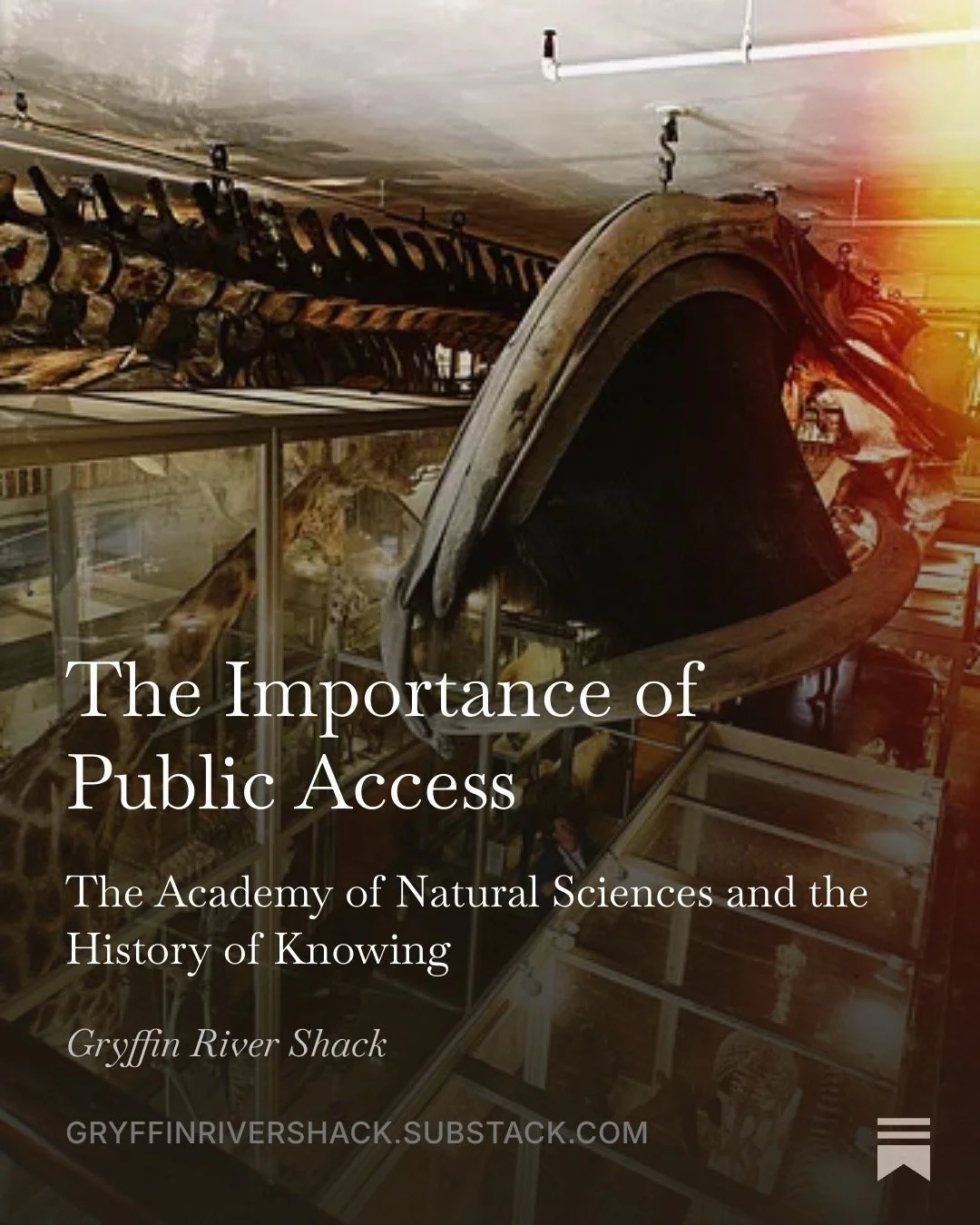
The first time I walked into Harvard’s Museum of Comparative Zoology, I was taken aback. I specifically remember the overwhelm of it, feeling claustrophobic and appalled. Animals stood stuffed, stuffed into glass cases with many other animals preserved in seemingly endless succession. Birds, mammals, skeletons, creatures, some materials that I had encountered alive, and others that I had only ever seen in photographs, were suddenly occupying the same physical space.
My first reaction was disturbance. I wondered why Harvard would continue to display natural history collections this way. Naively and arrogantly, I vowed that after graduation, I would one day come back to improve it.
To my twenty-first century eyes, the space was antiquated. I was accustomed at that point to more contemporary museums, such as the Houston Museum of Natural Sciences and the Smithsonian National Museum of Natural History, built around interpretation where one could expect carefully composed exhibitions, digital interactives, conservation narratives, and immersive environments, especially as we are being taught to “Reinvent the Museums”. Here, instead, were rows upon rows of ancient, dead animals.
As time went on, the longer I studied museums, particularly switching my focus to the history of science, the more that room changed for me. The exhibit didn’t change, I did. I began asking different questions. Instead of wondering why these specimens were still like this, I began wondering why and how someone had gone to such extraordinary lengths to bring them together in the first place, and continue to preserve them as such.
That question changed everything. It is also why the announced closure of the public museum at the Academy of Natural Sciences, currently of Drexel University in Philadelphia, unsettles me.
Before Cambridge, there was Philadelphia. The Academy of Natural Sciences was founded in Philadelphia in 1812 and opened its museum to the public in 1828. The Smithsonian Institution would not be established until 1846, and Harvard’s Museum of Comparative Zoology would follow in 1859. The Academy of Natural Sciences belongs to an extraordinarily early chapter in the institutionalization of American science.
Consider the year, 1812. There was no Smithsonian or Museum of Comparative Zoology, nor the electricity to illuminate them. There were no searchable databases, digital photographs, videography, internet, or instantaneous exchanges of information across continents. The transportation and communication networks that would later accelerate scientific exchange were still developing, if even yet an idea at all.
Yet, people were always attempting to understand the natural world. They did so through observation and collected material evidence. They collected and preserved what they encountered, such as shells, birds, skeletons, fossils, pressed plants, and field notebooks filled with drawings and observations.
Scientific evidence had to travel physically. It moved by human hands, wagons, ships, and eventually railroad. Museums and scientific institutions brought specimens gathered across distant environments into closer proximity, allowing scholars and scientists to examine, compare, classify, debate, and publish what they observed. Just as importantly, they preserved those materials so that future researchers could return to them with different questions.
The Academy was more than a place where objects accumulated. It was part of the infrastructure through which American scientific knowledge was produced, organized, preserved, and circulated. Its history is a history of epistemology.
This is what I did not understand when I first encountered Harvard’s collections. The decisions that had bothered me began to make sense. There were important reasons behind bringing these specimens together and maintaining the exhibition presentation until now. The museum allowed scholars and researchers to travel the world within one room and study objects up close in safety and controlled environments.
An animal encountered thousands of miles away, only heard about in stories, if ever heard about at all, could be collected and transported across an ocean. Eventually, it might sit in Cambridge or Philadelphia beside another organism collected somewhere completely different. A researcher could stand between them and notice similarities and differences that would have been almost impossible to ever encounter naturally, should they have had the opportunity to travel at all. Museums did something extraordinary for the times by bringing the collective world into an in-person comparative view.
To be clear, that does not mean that every conclusion drawn inside those rooms was correct. Science doesn’t work that way. Classifications changed, specimens were misidentified, theories were challenged, and names were revised. New technologies allowed old specimens to become newly relevant, answering questions that their collectors could never have anticipated originally. Further, collections were more often than not collected unethically.
That is what interests me- A natural history collection that preserves the material evidence of how people came to know, not just what scientists knew at the time, nor what the current “correct way” is to present the newest updated information.
Now, I find myself looking at specimens differently. Throughout my time in historic museums and throughout my Museum Studies courses, I’ve learned to ask better questions, such as:
Who found this specimen?
Where was it found? Who transported it and how?
Who preserved it? Who prepared it?
Who wrote the labels? What biases were present?
Who identified species. Who compared species?
Who published the resulting observations?
What was revised?
What can a researcher ask of that same specimen today that no one would have thought to ask of it in the time since the 1800’s?
A natural history specimen provenance documents two histories simultaneously- The history of an organism and the history of humans attempting to understand it. Once we recognize that, another set of questions becomes unavoidable.
It is easy to romanticize history with attached aesthetics. Although I am guilty of this myself, especially of the dark academia and natural history versions, we should not, without understanding the whole story first.
The history of American science is also a history of determining who was allowed to participate in science and given scientific authority. For much of the period represented by these collections, access to universities, learned societies, professional positions, formal education, and scientific recognition was shaped by race, gender, and class.
Women collected, illustrated, prepared, catalogued, and studied natural history while frequently encountering institutional barriers to the authority and recognition afforded to men. Indigenous people, African Americans, local experts, guides, and laborers contributed knowledge and work to scientific enterprises whose published conclusions did not acknowledge them as equal producers of knowledge. One of the questions that I increasingly find myself asking as I study the history of science is not simply, “What did we know?” It is, “Who was permitted to learn?”
Preserving institutions like the Academy does not require us to romanticize the world that created them. It gives us somewhere to continue to interrogate the knowledge that was discovered.
Who entered these rooms?
Who worked behind their doors?
Who collected the objects? Who told their stories?
Whose name appears on the publications? Whose name disappeared from the story?
The history of science is not diminished when we ask these questions. In fact, it instead becomes more complete. This is why the history of public access to scientific knowledge feels so remarkable to me. Consider the distance between 1812 and 2026… Knowledge that once required physical proximity to a specimen, library, university, or learned society can now appear on a phone screen in seconds by anyone.
I can stand beside a river, photograph an organism, and begin investigating its identity before I leave the bank. As previously touched on, now a student can examine digitized museum collections from hundreds of miles away, while researchers actively share data instantaneously across continents with like minds that they’ve never met. Members of the public can, and do, contribute observations to enormous citizen-science databases, like what you see done through Waterkeeper organizations. Scientific information has become accessible on a scale that an early nineteenth-century naturalist could scarcely have imagined.
This creates a paradox: The better we become at distributing information, the easier it becomes to look at the antiquated institutions that helped produce and preserve that information and wonder whether we still need them. This translates into what is funded, and where the funds are allocated.
Access to information is not the same thing as understanding where information came from. The internet did not spontaneously produce our accumulated knowledge of the natural world. Beside the searchable databases are Curators, Archivists, Preservators, Preparators, and the specimens they work with. Behind the specimens are labels. Behind the labels are research expeditions, correspondence letters, institutions, arguments, mistakes, exclusions, discoveries, and generations of accumulated observation and research. The proposed obsolescence of the old natural history museums may actually, instead, be the exact evidence of their continued success.
Of note, the Academy’s public museum is closing. The Academy itself is not. Drexel University and the Academy leadership have stated that scientific work will continue, with near-term attention focused on stewarding the Academy’s more than 19 million specimens and other scientific resources. Leadership has also described plans to seek financially sustainable ways of sharing elements of those collections with the public, somehow, in the future.
The reasons offered for the closure are multifaceted and muddy. Drexel appears to be pointing out ongoing post-pandemic changes in visitation and audience behavior, alongside increasing operating costs to maintain the old building. Continuing the museum in its current form is said to be increasingly competing for the resources necessary to preserve the collections and support research. Those are serious realities.
Historic buildings are expensive. Collections environments are expensive. Conservation is expensive. Research is expensive. Paying everyone needed for an ideal and effective museum staff is expensive. I don’t think we serve museums by pretending that those realities do not exist. But, acknowledging them does not resolve what happens when a public-facing space for encountering the history of science closes. It also does not answer the question of why other patrons and institutional collaborations were not thoroughly investigated before the announcement of closure.
For clarifying context, the Academy of Natural Sciences was not created by Drexel University. It existed for nearly eighty years before the Drexel Institute was founded in 1891. If you can believe it, their affiliation only began in 2011, almost two centuries after the Academy’s founding. The Academy retained its separate nonprofit identity and board, when becoming affiliated with Drexel. Therefore, this is not a simple story about a university closing one of its own museums. It is a story about what happens when one generation inherits or purchases a large institution created by the generations before it. What does stewardship require when what we inherit is expensive? What obligations accompany collections whose scientific usefulness may outlive everyone currently responsible for them? And what responsibility do we have to preserve meaningful public access to the histories that material objects represent?
Protecting the Academy’s research collections is essential. Allowing scientists to continue using them is essential. Digitizing them is important. To be fair, developing new ways of engaging the public may ultimately open up possibilities that we cannot yet see. But private research collections and a public museum do not perform the same functions.
A database can tell what a specimen is. A collection can allow a researcher to study it. But the magic of a museum is that it can put someone who has never thought about the history of science physically in front of a specimen and provoke thoughts that change people and the way that they interact with the world. As you have begun to understand, standing in rooms of scientific history and becoming curious about them opened up an entirely new world for me.
Institutions of science have spent generations, unevenly, imperfectly, but meaningfully, expanding the circle of people invited to participate in education and shared knowledge. The rooms in which scientific authority was once concentrated and exclusive among comparatively privileged populations have increasingly become inclusive places where school children, families, women, people of color, immigrants, people without advanced degrees, and people who may never describe themselves as scientists are explicitly invited to enter, often for free. That transformation matters.
Therefore, I cannot help but ask- After generations of expanding access to knowledge once concentrated among a privileged few, what does it mean to close the doors through which the public finally came to share in it?
I do not have an easy answer. Nor do I think keeping every historic museum permanently unchanged is the answer. Museums must evolve. But perhaps the evolution and preservation have been framed as opposites for too long.
Natural history collections teach us something profound about this problem. We cannot always know what information future generations will need. A scientist collecting an organism in the nineteenth century could not have anticipated DNA sequencing, modern toxicology, contemporary climate science, or many of the questions researchers can now ask of historical specimens. The specimen survived the limits of the question that originally caused someone to collect it. That is an extraordinary form of intellectual inheritance.
It also demands humility. When we decide what is no longer useful, we are making that judgement from within the priorities and knowledge of our own lived moments. Museums, archives, and scientific collections exist partly because previous generations oftentimes resisted that temptation. They preserved things without knowing for what purpose.
That question sits at the center of my own graduate research. My capstone looks toward very different places: nineteenth- and early twentieth-century American lighthouse stations and the people who lived and worked at the water’s edge. I am interested in how their observations of health, weather, water, animals, and the surrounding environments were made, recorded, transmitted, given authority, preserved, and eventually incorporated into larger systems of knowledge, like the National Archives. Lighthouse Keepers were concerned about the welfare of those traveling by boat. They probably never anticipated that their day to day activities and writings would be used to point to the historical evolution of natural sciences and medicines today by a student at Harvard University.
That is why the Academy’s closure feels relevant to my work rather than peripheral to it. It is not merely about losing a place to see old specimens, it is about preserving the evidence of how knowledge moves from observation into history.
I think again about my first encounter at the Museum of Comparative Zoology. Walking into that same space now, what first unsettled me is still there. The cases are still crowded, the animals are still dead and stuffed, but I no longer see only dead animals- I stand in awe of transformative epistemology.
I see field notebooks and handwritten labels, Collectors and Preparators, Scientists and Illustrators. Classification and reclassification. Women working within institutions that did not always recognize them equally. Knowledge contributed by people whose names never reached museum labels. Ideas once accepted and later rejected, and what came next. Technologies that transformed what could be learned from specimens collected generations before those technologies existed. Most of all, I see people trying to understand the world with the tools available to them.
The Academy of Natural Sciences belongs to an early chapter in America’s attempt to build places where observations of nature could accumulate into organized scientific knowledge. That doesn’t mean an institution founded in 1812 should remain frozen in 1812. We should continue to question the assumptions embedded in their collections. We should research the people their histories excluded. We should acknowledge where specimens came from and how they were acquired. We should use new technologies and new scholarship, and we should continue to make scientific knowledge accessible to people that their founders would have fought or fainted over if seen entering those rooms.
Access for everyone is arguably one of the greatest achievements of historical museums in the intervening two centuries. A visitor need not belong to a learned society or possess wealth, academic credentials, or social standing to walk through the door. A child can encounter a specimen collected two centuries before their birth. A student can discover a field they did not know existed. Someone whose ancestors might once have been excluded from the institutions that produced scientific authority can now enter, question the narrative, and participate in producing knowledge themselves. Those who couldn’t afford a college education can learn right alongside someone who completed their PhD.
While that progress is incomplete, it is still profound. That is what makes the possibility of losing public access so troubling. If scientific collections increasingly retreat from public spaces into environments accessible principally to specialists, researchers, private institutions, or those with the credentials necessary to gain entry, then something fundamental changes, even if every specimen remains perfectly preserved. We risk moving backward toward a model in which knowledge exists, but access to the places where that knowledge is preserved is once again limited. Knowledge may be safeguarded but not shared, preserved, not encountered. Available, perhaps, but no longer truly public.
Modernization should not require forgetting where the room came from and preservation should not mean preserving the collection while losing the doorway. If we preserve only what science knows now while losing the places that show us how we learned to know it, we risk preserving the answers while forgetting the important questions and the people that made those answers possible. We risk losing the knowledge of how knowledge fought and grew. After generations of widening the circle of who gets to stand in historical rooms, I hope we do not accept the closing of their doors quietly now.
This is not an argument against the difficult decisions sometimes required to protect collections. It is an argument for remembering how extraordinary public access itself is, how long it took us to get here, who is destroying the access, and how we collectively are responsible to continue to insure that knowledge and public access persists.
