
Position Against the Possession and Display of Human Remains: Harvard Art Crimes Course With Professors Anthony Amore and Geoffrey Kelly, Retired FBI Art Crimes Team
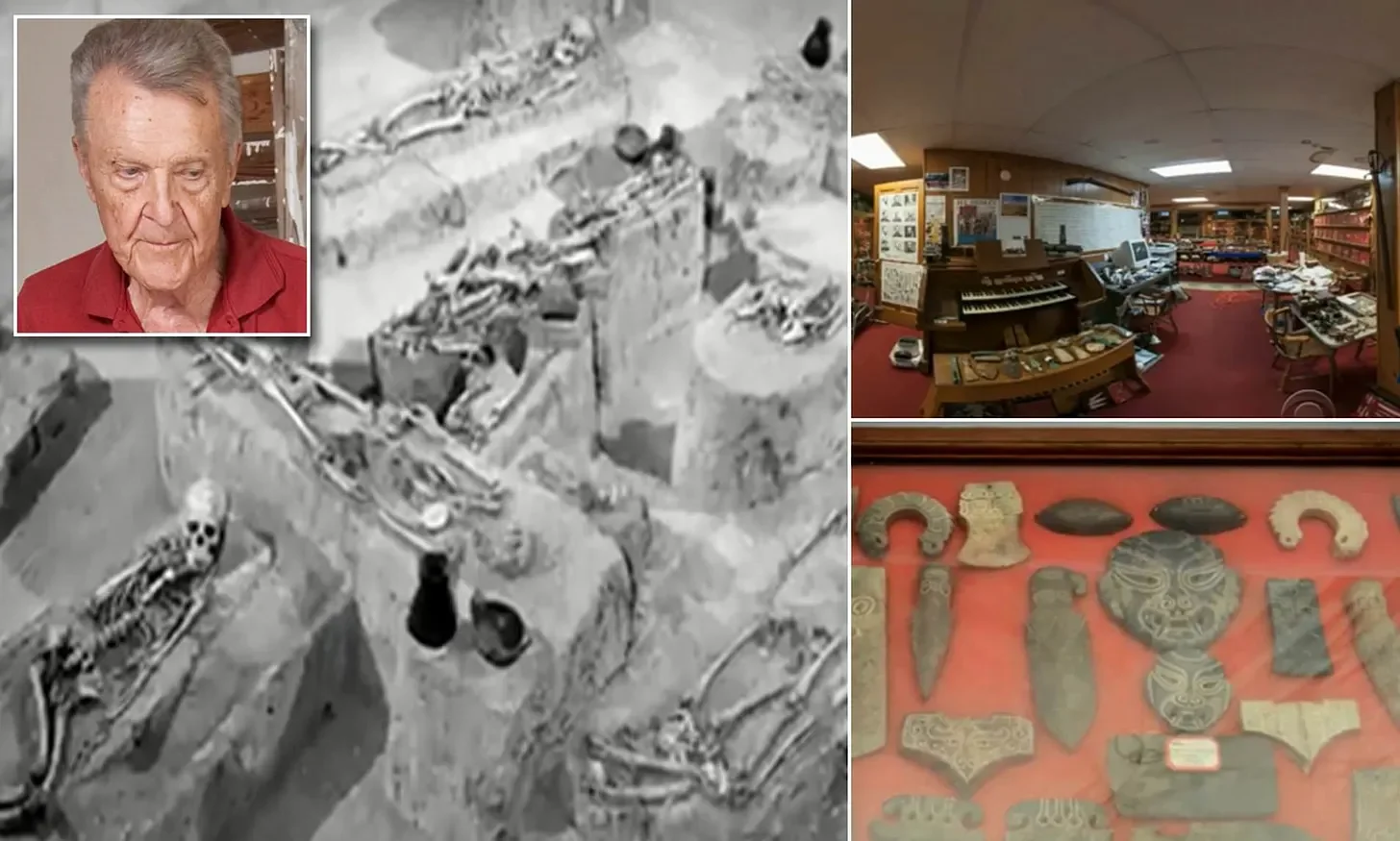
Images: The Daily Mail
Donald Miller, an Indiana collector whose life ironically evoked an Indiana Jones style narrative, amassed more than 42,000 artifacts over decades (Katz), transforming his home into a museum. What ultimately drew legal attention to him was not the scale of his collection, rather the amount of human remains discovered, initiating one of the largest FBI recoveries of illicit cultural property in US history (Katz). Central to understanding the legal gravity of this case is 108 STAT.2124, a federal statute that criminalizes the theft, receipt, or trafficking of personal property/cultural heritage resources, including archaeological materials and human remains (US Code). Miller’s case exposes violation of modern law and a deeper ethical failure in the treatment of human bodies. While his actions are widely condemned, they are not far off from institutional practices. Museums have long participated in the acquisition and display of mummified humans. When examined through the lenses of religion, burial practices, consent, and human dignity, the display of mummified bodies reflects the same ethical violations that define the legacy of Don Miller.
Egyptian mummification was a sacred religious practice rooted in beliefs regarding the afterlife, rather than the anthropological science banner that bodies are currently displayed under. The preservation of a body was essential to ensuring the soul’s successful transition to afterlife beyond death (National Geographic). Each stage of mummification, from careful preparation of the body to the ritual wrapping and burial, was conducted with intention, ceremony, and reverence. Removing a human body from a tomb and placing them on display in a museum violates these beliefs. It transforms a person intentionally laid to rest into an object, a mummy, stripped of cultural, spiritual, and personal dignity.
While museums justify display through education and cultural preservation, these arguments do not resolve the absence of consent. The individual displayed did not agree to be removed, studied, or exhibited, and their culture speaks for them in stark contrast to what the museum is claiming to protect. Yet, ethical legitimacy cannot be granted solely through institutional authority. The existence of laws such as 108 STAT.2124 underscores that the unauthorized possession of cultural heritage, especially human remains, is not only controversial, but prosecutable, raising an alarm as to why similar standards have not been uniformly applied to individuals like Miller.
The origin of museum collections helps explain how such practices became normalized. Major museums developed their collections during periods of colonial expansion when powers exerted control over foreign lands. Archaeological expeditions operated with minimal oversight, like during wartime, blurring lines between scientific inquiry and grave robbing. Burial sites were treated as sources of value rather than as sacred, and human remains were frequently removed alongside funerary artifacts without modern acquisition documentation or consent. As Indiana Jones would have said, “These belong in a museum!” Practices stemming from this mindset developed justified narratives to education and discovery for a world dying of curiosity for the unknown, in an era without modern technology to view it; but they relied on the dehumanization and the “otherness” of individuals, whose bodies were stolen, to abate it.
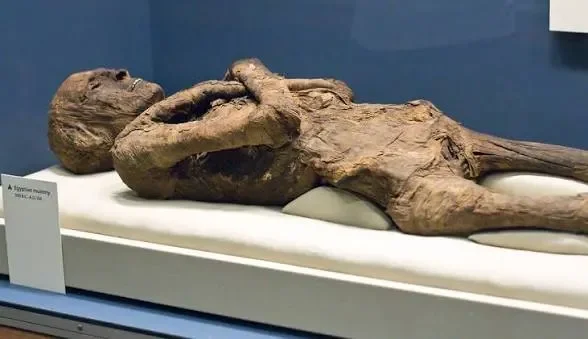
Image: Smithsonian National Museum of Natural History
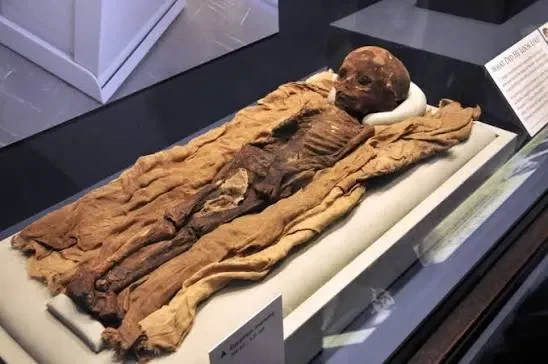
Image: Smithsonian National Museum of Natural History
Images: Smithsonian National Museum of Natural History
The continued display of bodies in modern times perpetuates the colonial legacy of rape and enslavement. Even accompanied by interpretive text or educational framing, the act of bodily exhibition reduces a human life to a pleasure experience. It reinforces a dynamic where institutions maintain authority and control over a human. In modern contexts, informed consent is the foundational ethical principle governing any interaction with a human body, alive or dead, particularly in medicine and research. Consent requires clear communication, voluntary participation, and the ability to withdraw it at any time with a power of attorney acting on your behalf towards your wishes if you are not able to speak for yourself. None of these conditions apply to mummified individuals.
While true that the study of mummified remains contributed to knowledge of ancient times, the societal benefits have played out. Legal framework beyond 108 STAT.2124 reflects this shift in ethical understanding. NAGPRA, for example, recognizes the rights of descendant communities to reclaim human bodies and sacred objects (National Park Service). Although this law applies specifically to Indigenous people in the U.S., its underlying principles of respect, consent, and cultural sovereignty extend beyond its legal scope. These laws signal societal recognition that human bodies are not objects and should not be treated as such, in private collections or in public institutions.
In many museums, empty cases and explanatory signage serve as visible acknowledgement of attempted correction to past injustices. Ultimately, the continued display of bodies in museums must be understood as an ethical issue rooted in outdated colonial practices. If the actions of private collectors like Donald Miller are recognized as violations of both law and ethics, then consistency demands that similar practices within institutions be held to the same standard.
Works Cited
Katz, Brigit. “The F.B.I. Is Trying to Return Thousands of Stolen Artifacts, Including Native
American Burial Remains.” Smithsonian Magazine, 4 Mar. 2019,
https://www.smithsonianmag.com/smart-news/fbi-trying-return-thousands-stolen-
artifacts-including-native-american-remains-amassed-indiana-collector-180971604/.
Accessed 30 Mar. 2026.
National Park Service. “Native American Graves Protection and Repatriation Act of 1990 -
Archeology (U.S. National Park Service).” Www.nps.gov, 12 Jan. 2023,
https://www.nps.gov/subjects/archeology/napgra.htm. Accessed 30 Mar. 2026.
“Public Law 103-322.” United States Code, Office of the Law Revision Counsel, 13 Sept. 1994,
uscode.house.gov/statviewer.htm?volume=108&page=2124. Accessed 30 Mar. 2026.
